Are Slow Upload Speeds Caused by the Modem or Router?
Introduction
There are a number of issues that tin can affect the performance and speed of cable modems in a Data-over-Cable Service Interface Specifications (DOCSIS) system. This document seeks to address the major causes of dull throughput from the perspective of a cablevision service provider.
This document first looks at how to decide accurately what kinds of throughput levels an end user is achieving and how to make sure that the performance being measured is that of the cable network, rather than that of the broader Internet.
The side by side department looks at the most mutual potential reasons for slow performance and suggested resolutions. These issues include:
-
Performance being restricted by the limits in the DOCSIS configuration file.
-
Bursty or inconstant download functioning caused past using a sub-optimal rate limiting scheme on the cablevision modem termination system (CMTS).
-
Upstream and downstream channel congestion.
-
Backhaul network or Internet congestion.
-
Noise or errors on the cablevision constitute.
-
Under powered finish user customer premises equipment (CPE).
Each of these individually or in combination can touch throughput and operation in a cable network.
This document does not hash out troubleshooting a complete loss of connectivity over the cable network or cable modems not coming online. Instead, refer to Troubleshooting uBR Cable Modems Not Coming Online for these kinds of problems.
Before You Begin
Prerequisites
There are no specific prerequisites for this document.
Components Used
The information in this document is based on the software and hardware versions beneath.
-
Cisco IOS® Software Release 12.1(9)EC for the uBR7200 and uBR7100 CMTS.
-
The Cisco uBR7100, uBR7200, and uBR7200VXR suite of CMTS products.
-
The information in this document is relevant for all other currently available releases of DOCSIS one.0-based Cisco IOS software for Cisco brand CMTS equipment.
The information presented in this certificate was created from devices in a specific lab surroundings. All of the devices used in this document started with a cleared (default) configuration. If yous are working in a live network, ensure that you understand the potential affect of any control earlier using it.
Accurately Determining the Levels of Performance Being Accomplished
Measuring the Right Parts of the System
There are a number of ways to gauge the speed and performance of a organisation, however information technology is important to understand exactly what parts of the arrangement are being tested. Consider the diagram below.
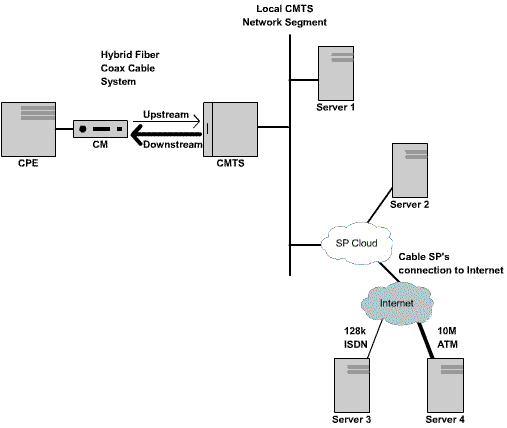
Figure 1 (To see this diagram in video format, click here.)
In this diagram there are a number of components:
-
The Hybrid Fiber Coax network between the end user and the CMTS.
-
The Local CMTS network segment where the CMTS connects to the cable service provider's network.
-
The cable service provider's internal network.
-
The public Cyberspace.
When performing a speed test between two points, the speed of all the network components between the 2 points is being measured.
For example, if performing a speed exam between the CPE and Server 3, which is connected to the Net through a 128 Kbps ISDN line, there never will be speeds of greater than 128 Kbps, even if the available bandwidth on the cable segment is greater then 128 Kbps.
The most accurate way to mensurate the operation of the cablevision segment itself is to perform a speed test between the CPE and Server 1, which is connected to the same network segment as the CMTS. This is because the only path data needs to travel over is the coaxial cablevision segment. The data also must travel across the local CMTS network segment, but it is presumed this segment is of a loftier bandwidth (FastEthernet or greater) and does not have a high level of congestion.
If for some reason, no server can exist continued to the local CMTS network segment, then the side by side most authentic mode to examination the operation of the cable segment is to perform a speed test between the CPE and Server 2. This is an accurate measurement as long equally at that place are fairly high speed and uncongested links within the cablevision service provider's internal network betwixt the CMTS and the CPE.
The near inaccurate fashion to determine the performance of the cable segment is to perform a speed test between the CPE and a server on the public Internet. This is because in that location may be congested links in the public Internet betwixt the CPE and the server, or there may exist very low speed links in the path betwixt the CPE and the server on the Internet.
Determining the Download and Upload Rate
It is very important to be able to get an objective measurement of exactly what levels of upload and download throughput are being achieved before whatsoever conclusions can be made about whether a performance problem exists in a DOCSIS organisation.
The easiest style to determine the speed at which uploads and downloads are occurring is to upload or download a large file using FTP or HTTP between a CPE device connected to a cable modem, and a server behind the CMTS. Most FTP and HTTP clients are able to display the speed at which a download or an upload is occurring either during the transfer or once the transfer is complete. The transfer speed seen every bit a result of the FTP or HTTP operation is typically about ninety percentage of the true total throughput attained. This is considering the displayed FTP or HTTP transfer speed does non take into account extra IP and DOCSIS overhead that needs to travel between the CPE device and the CMTS.
There are more accurate methods of measuring throughput, for case by using third-party dedicated testing equipment, such equally a Netcom Smartbits or a IXIA package generator, even so these systems are not always readily available or hands connected to a production cable network. Information technology is worth noting that if throughput tests are being carried out in a lab surroundings, then using a dedicated device volition reveal much more information than the uncomplicated FTP or HTTP download exam.
Note:The FTP- or HTTP-based upload and download examination is only reliable for testing speeds of around 3 Mbps or less. At higher speeds the processing power of the CPE device, server or Network Interface Cards (NIC) may become a limiting factor in the test. For testing speeds higher than nigh three Mbps, defended data throughput testing equipment should exist used.
In the following example, a unproblematic FTP download and upload test is performed between a CPE device connected to a cablevision modem, and an FTP server on the cable service provider's network. The cablevision modem has downloaded a DOCSIS configuration file that allows a download speed of up to 256 Kbps and an upload speed of up to 64 Kbps. In this test, a 3 Mb file has been placed on the FTP server at IP address 172.17.110.132. The user of the CPE device is given a username and password in order to exist able to log into the FTP server so they can download this file from the FTP server, and and then upload it back to the FTP server. The control line FTP utility is used to perform the transfer. This utility is available in about all versions of Microsoft Windows and UNIX.
A similar exam is conducted by having an HTTP web server set up in the service provider's network and performing an HTTP download.
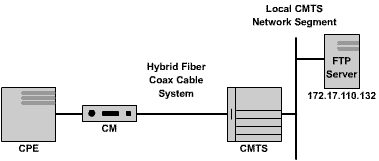
Figure ii
Note: !--- Comments are in blue. C:\>ftp 172.17.110.132 !--- Initiate the FTP session to the server. Connected to 172.17.110.132. 220 Solaris FTP server (SunOS 5.6) set. User (172.17.110.132:(none)): anonymous !--- Enter the FTP server username. 331 Guest login ok, send your complete e-post address equally countersign. Password: user@samplenetwork.com.au !--- Enter the FTP server countersign. 230 User bearding logged in. ftp> dir !--- View the contents of the electric current directory. 200 PORT command successful. 150 ASCII data connection for /bin/ls (64.104.207.118,1282) (0 bytes). total 74932 -rw-r--r-- 1 root other 3276800 Oct x 19:31 cable.txt !--- A iii 1000 file that you can download. 226 ASCII Transfer complete. ftp: 105 bytes received in 0.12 Seconds two.46 Kbytes/sec. ftp> bi !--- Turn on Binary File transfer manner. 200 Blazon fix to I. ftp> become cable.txt !--- Retrieve the file cable.txt and wait for it to download. 200 PORT command successful. 150 Binary data connection for cable.txt (192.168.1.13,3154) (3276800 bytes). 226 Binary Transfer complete. ftp: 3276800 bytes received in 111.35 Seconds 29.43 Kbytes/sec. !--- Download complete. It seems that the download occurred !--- at 29.43 Kbytes/sec, which equals 235 Kbits/sec. This is near 90 pct of !--- the allowed 256 Kbps download rate for the modem being tested. ftp> put cable.txt !--- Brainstorm uploading the file. You lot need to make sure you lot have !--- the correct access in society to upload a file to the FTP server or !--- you may get an access-denied error. 200 PORT command successful. 150 Binary information connexion for cable.txt (192.168.1.13,3157). 226 Transfer complete. ftp: 3276800 bytes sent in 432.49 Seconds 7.58 Kbytes/sec. !--- Upload Consummate. Here you lot meet the upload !--- occurred at 7.58 Kbytes/sec, !--- which is equivalent to 60.64 Kbits/sec. This !--- is about xc percent of the allowed !--- 64 Kbps upload rate for the modem being tested. ftp> quit !--- Exit the FTP client application. 221 Goodbye.
While the FTP transfer is occurring, it is possible to monitor the progress of the test on the CMTS using the bear witness interface cable X/Y sid Z counters command where cablevision 10/Y is the cable interface the modem under test is connected to, and Z is the Service ID (SID) number of the modem under test. This command shows how many bytes are being transferred from or to a particular cable modem. For example, if the CPE being tested is backside a cablevision modem with MAC address 0001.9659.4461.
First notice the SID number of the modem existence tested by using the show cablevision modem command. In this case the SID of the cable modem is 5.
uBR7246-VXR# show cable modem 0001.9659.4461 Interface Prim Online Timing Rec QoS CPE IP address MAC address Sid State Offset Ability Cable3/0/U0 5 online 1996 0.25 5 2 10.1.one.24 0001.9659.4461
While the download or upload is progressing, articulate all the packet counters on the CMTS dorsum to cypher using the clear counters control. Exactly when the counters are cleared, kickoff a stopwatch or timer.
uBR7246-VXR# clear counters !--- Reset parcel counter to cypher. Clear "prove interface" counters on all interfaces [confirm] !--- Start the stopwatch when you striking Enter.
After the stopwatch or time reads exactly one infinitesimal, consequence the testify interface cable Ten/Y sid Z counters command. It may be best to type the command first and and then hit Enter exactly when the timer indicates ane minute. The test tin be performed over a longer or a shorter menstruation. The longer the exam period, the more accurate the outcome, withal brand certain that the download or upload does not terminate before the stopwatch timer reaches the specified time, otherwise the measurement is inaccurate.
uBR7246-VXR# show interface cable 3/0 sid five counters !--- Hitting enter when stopwatch is at exactly 1 infinitesimal. Sid Inpackets Inoctets Outpackets Outoctets Ratelimit Ratelimit BWReqDrop DSPktDrop 5 4019 257216 3368 1921488 0 149 uBR7246-VXR# In this example download speed is being tested. The output of the prove interface cable Ten/Y sid Z counter command indicates that over a menstruation of i minute, 1,921,488 bytes is downloaded by the cable modem. Converting 1,921,488 bytes into $.25 reveals:
8 $.25 per byte * i,921,488 bytes = fifteen,371,904 bits.
Then, to find the download rate in bits per second, divide this total number of bits downloaded by the time it takes to download them in seconds.
15,371,904 bits / lx seconds = 256 Kbps.
The download rate in this example is shown to be approximately 256 Kbps, which happens to exist the immune download charge per unit for the cable modem nether test.
In order to look at the upload speed using the evidence interface cable X/Y sid Z counters control, the Inoctets column should be used to make up one's mind the number of bytes sent in the upstream direction from the cable modem.
See the Cisco Broadband Cablevision Command Reference Guide for more information about the show interface cable sid counters command.
Potential Reasons for Poor Operation
Operation Restricted by DOCSIS Configuration File
The beginning piece of information that needs to be gathered when troubleshooting ho-hum cable modem operation is the prescribed class of service throughput limitations of the cablevision modem. When a cable modem comes online, it downloads a DOCSIS configuration file that contains operational limits for the cable modem, including the maximum upload and download rates. Nether normal circumstances, the cable modem is not immune to exceed these rates.
Initially it is necessary to identify the MAC address of a cable modem having problems. Taking a modem with MAC address 0050.7366.2223 that is having problems with slow throughput,. it is necessary to find out what grade of service profile this cablevision modem is using past executing the testify cablevision modem <mac-address> command as seen in the instance below.
uBR7246-VXR# show cable modem 0050.7366.2223 Interface Prim Online Timing Rec QoS CPE IP address MAC accost Sid State Commencement Power Cable3/0/U1 i online 1548 0.75 5 0 10.1.1.10 0050.7366.2223
Here information technology shows this cable modem has a Quality of Service (QoS) profile of v. In order to find out what downstream and upstream rates this QoS profile corresponds to, apply the show cablevision qos profile profile-number command, where profile-number is the QoS profile of involvement.
uBR7246-VXR# bear witness cablevision qos profile 5 ID Prio Max Guarantee Max Max TOS TOS Create B IP prec. upstream upstream downstream tx mask value past priv rate bandwidth bandwidth bandwidth burst enab enab 5 0 64000 0 256000 1600 0x0 0x0 cm no no
Here it shows that QoS contour v corresponds to a service providing 256 Kbps in the downstream and 64 Kbps is the upstream. Whatsoever CPE continued to cable modems using QoS profile 5 are not able to exceed these limits. The QoS profile settings are determined by the contents of the DOCSIS configuration files downloaded past cable modems from the provisioning organization's TFTP server, therefore QoS profile five in the system may not be the same as QoS profile 5 in the example shown above.
If an finish user's download and upload performance correlate with the limits shown in their QoS profile, then they are getting the class of service and throughput levels for which the cablevision modem has been provisioned and configured. The only way to increase the upload and download throughput is to modify the DOCSIS configuration file existence downloaded past the cablevision modem to 1 that has higher throughput limits. Encounter the certificate entitled Building DOCSIS one.0 Configuration Files Using Cisco DOCSIS Configurator for detailed instructions on how to create or modify a DOCSIS configuration file.
Using a Sub-optimal Method for Rate Limiting
When an end user is trying to download data from the Cyberspace at a charge per unit greater than their cable modem's DOCSIS configuration file allows, the CMTS must rate limit the traffic being sent to that user to ensure that the user does not consume more than their immune share of bandwidth.
Similarly, when an stop user tries to upload or send data to the Net at a rate greater than what the DOCSIS configuration file allows, the cable modem itself should stop the excess traffic from traveling over the cable segment to the CMTS. If the cablevision modem, for some reason, fails to perform upstream rate limiting properly, so the CMTS explicitly forbids the cable modem from transmitting college than the allowed rate. This beliefs on the CMTS is to ensure that even a cablevision modem with "hacked" characteristics is unable to subvert the service provider assigned upload rate limits.
The default rate-limiting scheme used by the CMTS monitors the rate of traffic to or from each cable modem over every i-second period. If the cable modem sends or receives more its per second quota in less than a second, then the CMTS does not permit any more traffic to menses to that cable modem for the remainder of the 2nd.
As an example, take a cable modem with a QoS profile assuasive a download rate of 512 Kbps. If the cable modem downloads 512 kilobits (64 kilobytes) inside the first half of a second, then for the side by side half of the second, the cable modem is not allowed to download annihilation. This type of rate limiting beliefs may have the result of a bursty download blueprint that seems to stop and outset every second or two.
The best downstream rate-limiting scheme to apply is the token bucket rate-limiting algorithm with traffic shaping. This rate-limiting scheme has been optimized to let for a smoothen spider web browsing experience at a steady rate, while at the same fourth dimension ensuring that terminate users are non allowed to exceed the prescribed download charge per unit as specified in the DOCSIS configuration file.
The manner this scheme works is to measure the charge per unit at which a cablevision modem is downloading or uploading data each time a packet is sent to or from the cable modem. If sending or receiving the package in question causes the modem to exceed its allowed transfer rates, then the packet is buffered or cached in CMTS memory until the CMTS tin transport the packet without exceeding the downstream bandwidth limit.
Note:If the downstream traffic charge per unit consistently exceeds the allowed downstream rate for the cable modem, then packets are somewhen dropped.
Past using this smoother method of rate limiting and shaping, virtually TCP-based Cyberspace applications such as HTTP web browsing and FTP file transfers operate more smoothly and efficiently than when using the default rate-limiting scheme.
The token-bucket rate-limiting-with-traffic-shaping scheme can be enabled on the downstream path on a cable interface by issuing the following cable interface configuration command:
uBR7246-VXR(config-if)# cable downstream rate-limit token-saucepan shaping
Notation:Information technology is highly recommended to enable token-saucepan shaping on the user'southward CMTS. This control is supported as of Cisco IOS Software Releases 12.0(5)T1 and 12.ane(1)EC1.
The token-saucepan with traffic shaping scheme also can be applied to upstream ports, but since information technology is the responsibility of the cable modems to perform upstream charge per unit limiting, the upstream rate-limiting scheme applied to the CMTS normally will non have any bear on on the operation of a system.
uBR7246-VXR(config-if)# cable upstream 0 charge per unit-limit token-bucket shaping
See the Cisco Broadband Cable Command Reference Guide for more information about the cablevision downstream rate-limit and cablevision upstream charge per unit-limit commands.
Users can view how severely the CMTS is rate limiting traffic to a particular cable modem past using the show interface cablevision X/Y sid <Z> counters command, where cablevision X/Y is the cablevision interface to which the cable modem is continued, and Z is the SID number of the modem being observed. This control shows the number of times the CMTS has dropped a downstream packet or refused to allow an upstream package due to the modem exceeding its allowed throughput limits. If no value is specified for Z, then counter information for all cable modems connected to interface cablevision Ten/Y are displayed.
uBR7246-VXR# prove interface cable 3/0 sid 5 counters Sid Inpackets Inoctets Outpackets Outoctets Ratelimit Ratelimit BWReqDrop DSPktDrop 5 150927 9662206 126529 72008199 0 5681
The Ratelimit DSPktDrop field shows how many times the CMTS has dropped packets destined for the cable modem due to the modem trying to exceed its immune downstream throughput.
The Ratelimit BWReqDrop field shows how many times the CMTS has refused to allow a cable modem send a packet in the upstream path due to the modem trying to exceed its allowed upstream throughput. In near circumstances this counter always should remain at 0. If information technology rises significantly higher up zero, it may exist that the cable modem being observed is non performing upstream rate limiting properly.
Note:The values displayed by the show interface cable X/Y sid Z counters control may exist reset to zero by issuing the clear counters control as seen in the example below.
uBR7246-VXR# prove interface cable 3/0 sid counters Sid Inpackets Inoctets Outpackets Outoctets Ratelimit Ratelimit BWReqDrop DSPktDrop 1 vii 1834 vii 1300 0 0 2 2052 549150 0 0 0 0 3 2 1244 two 708 0 0 4 2 1244 ii 714 0 0 5 160158 10253220 134294 76423270 0 6023 6 2 1244 two 712 0 0 7 9 1906 iv 858 0 0 9 6 1076 three 483 0 0 12 616 165424 0 0 0 0 uBR7246-VXR# clear counters Clear "show interface" counters on all interfaces [ostend] <printing enter hither> uBR7246-VXR# show interface cable 3/0 sid counters Sid Inpackets Inoctets Outpackets Outoctets Ratelimit Ratelimit BWReqDrop DSPktDrop 1 0 0 0 0 0 0 two 0 0 0 0 0 0 3 0 0 0 0 0 0 four 0 0 0 0 0 0 5 111 7104 92 52728 0 six vi 0 0 0 0 0 0 7 0 0 0 0 0 0 nine 0 0 0 0 0 0 12 0 0 0 0 0 0
Encounter the Cisco Broadband Cable Command Reference Guide for more data about the show interface cable sid counters control.
Upstream Channel Congestion
The upstream channel is normally the almost precious resource in a cablevision system. Currently, near cable service providers use a ane.six MHz aqueduct width and Quadrature Stage Shift Keying (QPSK) modulation in the upstream path. This equates to approximately 2.5 Mbps in total available upstream bandwidth for all users connected to the one upstream channel. It is of import to ensure that the upstream channel does not become over used or congested, otherwise all users on that upstream segment suffer poor functioning.
The upstream usage for a item upstream port can be obtained past executing the CMTS command evidence interface cable X/Y upstream <Z>, where cablevision X/Y is the downstream interface number and Z is the upstream port number. If Z is omitted, information for all upstreams on interface cable X/Y will exist displayed. Come across the Cisco Broadband Cable Command Reference Guide for more than information near the prove interface cablevision upstream command.
uBR7246-VXR# show interface cable 6/0 upstream 0 Cable6/0: Upstream 0 is upward Received 71941 broadcasts, 27234 multicasts, 8987489 unicasts 0 discards, 140354 errors, 0 unknown protocol 9086664 packets input, 4394 uncorrectable 122628 noise, 0 microreflections Total Modems On This Upstream Channel : 359 (354 active) Default MAC scheduler Queue[Rng Polls] 0/64, fifo queueing, 0 drops Queue[Cont Mslots] 0/104, fifo queueing, 0 drops Queue[CIR Grants] 0/64, off-white queueing, 0 drops Queue[BE Grants] 0/64, off-white queueing, 0 drops Queue[Grant Shpr] 0/64, calendar queueing, 0 drops Reserved slot table currently has 0 CBR entries Req IEs 64609697, Req/Data IEs 0 Init Mtn IEs 521851, Stn Mtn IEs 569985 Long Grant IEs 2781600, Brusk Grant IEs 2067668 Avg upstream aqueduct utilization : 18% Avg percent contention slots : 77% Avg percent initial ranging slots : 2% Avg pct minislots lost on belatedly MAPs : 0% Full channel bw reserved 37858000 bps CIR admission control not enforced Access requests rejected 0 Current minislot count : 7301855 Flag: 0 Scheduled minislot count : 7301952 Flag: 0
On the upstream port seen in the instance, the upstream usage is currently eighteen per centum and in that location are 359 modems connected to this upstream.
If upstream channel usage is consistently above 75 pct during the meridian usage time, stop users brainstorm to suffer issues such every bit latency, slower "ping" times, and a generally slower Internet experience. If upstream aqueduct usage is constantly above xc per centum during the peak usage time, cease users experience an extremely poor level of service because a large portion of the stop user's upstream information will take to be delayed or discarded.
Upstream channel usage changes during the twenty-four hours as dissimilar users have an opportunity to utilize their cablevision modem, so it is important to monitor the upstream usage during the busiest times of the day rather than at low usage times.
Ways of relieving upstream congestion include:
-
Reducing the number of cable modems per upstream – If there are too many cable modems continued to a item upstream, or if users on a particular upstream are heavy users of upstream bandwidth, the best solution is to move some users on the congested upstream port to an nether used upstream port, or to a completely new upstream port. This is typically achieved by moving a fiber node from one upstream combining group to another, or splitting an upstream combining group into two separate combining groups. For more information, refer to What is the Maximum Number of Users per CMTS.
-
Increasing the upstream channel width – This involves a rigorous and thorough analysis of the upstream spectrum to detect a wide plenty band with adequate Signal-to-Noise Ratio (SNR) characteristics to back up the increased channel width. The upstream channel width should non be changed without conscientious planning because this alter potentially can affect other services in the user'due south cable system. The upstream aqueduct width may exist inverse by using the cablevision interface command cablevision upstream Z aqueduct-width <new-channel-width> where Z is the upstream port number and new aqueduct width is one of 200000, 400000, 800000, 1600000 (the default) or 3200000. An example follows.
uBR7246-VXR(config-if)# cable upstream 0 channel-width 3200000
Encounter the Cisco Broadband Cable Control Reference Guide for more data well-nigh the show interface cablevision upstream command.
-
Irresolute the upstream digital modulation scheme to 16-Quadrature Aamplitude Modulation (QAM) – Once once more, this requires a rigorous and thorough analysis of the upstream spectrum in order to verify whether there is a frequency band in the upstream available that can support 16-QAM modulation. If this analysis is not performed properly, there is a gamble that performance is farther decreased or a complete upstream outage may occur. The upstream modulation scheme may be inverse by creating an upstream modulation contour that uses 16-QAM modulation and then applying that to an upstream port. An instance follows.
uBR7246-VXR(config)# cablevision modulation-profile ii mix !--- Create an optimized 16-qam/qpsk modulation contour. uBR7246-VXR(config)# interface cablevision vi/0 uBR7246-VXR(config-if)# cable upstream 0 modulation-profile 2See the Cisco Broadband Cable Command Reference Guide for more information about the cable modulation-profile and cable upstream modulation-profile commands. See besides Configuring Cablevision Modulation Profiles on Cisco's Cable Modem Termination Systems.
-
Reducing the allowed upstream throughput per cablevision modem – By reducing the maximum upstream transmit charge per unit in the appropriate DOCSIS configuration files, cable modem users are non able to transmit at as loftier a rate in the upstream direction and upstream congestion is relieved. The negative aspect of this course of activeness is that cablevision modem users are limited to a slower grade of service. Encounter Building DOCSIS one.0 Configuration Files Using Cisco DOCSIS Configurator.
Annotation:The measures discussed in this section practice not significantly increase the performance of an already uncongested system.
Downstream Channel Congestion
The downstream channel has significantly more than bandwidth to share than an private upstream channel, therefore the downstream is non commonly as subject to congestion as the upstream. Still, more users typically share a downstream aqueduct than any single upstream channel, so if the downstream channel becomes congested, all users connected to the downstream segment feel reduced performance.
The following tabular array shows the total bachelor downstream bandwidth associated with the iv possible downstream modulation schemes available in DOCSIS systems.
| Downstream Modulation Scheme | Bachelor Downstream Bandwidth |
|---|---|
| 64-QAM N American DOCSIS | 27 Mbps |
| 256-QAM North American DOCSIS | 38 Mbps |
| 64-QAM Euro DOCSIS | 38 Mbps |
| 256-QAM Euro DOCSIS | 54 Mbps |
The majority of DOCSIS cable systems currently deploy 64-QAM Due north American DOCSIS and therefore have 27 Mbps available per downstream aqueduct.
Downstream aqueduct usage can be determined by issuing the show interface cable X/Y command, where cablevision Ten/Y is the cable interface existence observed. The displayed output rate in $.25 per second should be compared to the available downstream bandwidth as seen in the tabular array higher up.
In the following example, an interface using North American DOCSIS and 64-QAM digital modulation is analyzed.
uBR7246-VXR# evidence interface cablevision three/0 Cable3/0 is up, line protocol is up Hardware is BCM3210 ASIC, address is 0005.5fed.dca4 (bia 0005.5fed.dca4) Internet address is x.one.1.1.1/24 MTU 1500 bytes, BW 27000 Kbit, DLY chiliad usec, reliability 255/255, txload nine/255, rxload 5/255 Encapsulation MCNS, loopback non set up Keepalive not prepare ARP blazon: ARPA, ARP Timeout 04:00:00 Last input 00:00:00, output 00:00:00, output hang never Last clearing of "prove interface" counters 00:45:01 Input queue: 0/75/0/0 (size/max/drops/flushes); Total output drops: 0 Queueing strategy: fifo Output queue :0/xl (size/max) 5 infinitesimal input charge per unit 587000 bits/sec, 228 packets/sec 5 minute output rate 996000 bits/sec, 239 packets/sec 85560 packets input, 8402862 bytes, 0 no buffer Received 1013 broadcasts, 0 runts, 0 giants, 0 throttles 247 input errors, 35 CRC, 0 frame, 0 overrun, 0 ignored, 0 abort 65912 packets output, 38168842 bytes, 0 underruns 0 output errors, 0 collisions, 0 interface resets 0 output buffer failures, 0 output buffers swapped out
The first component of this output to notation is the bandwidth of the interface indicated past the BW parameter. In Cisco IOS Software Releases 12.one(viii)EC and afterwards, this value is adjusted automatically co-ordinate to the downstream modulation scheme and version of DOCSIS being used. In revisions earlier than Cisco IOS Software Release 12.ane(8)EC, this value must be configured manually using the cablevision interface command bandwidth <bandwidth-in-kilo-bits-per-second> or otherwise information technology remains at the default value of 27000 Kbps.
The 2nd component to note is the manual load as indicated by the txload parameter. This parameter gives a metric out of 255 where 0/255 means that no traffic is flowing in the downstream direction to 255/255, which means data is traveling in the downstream at the maximum possible rate (in this example at 27000 Kbps). If this parameter is running consistently at greater than approximately 75 percent during the peak usage time (for example, greater than 191/255), end users showtime to experience slower Internet access and higher latency.
The tertiary component to note is the output rate, which shows the average downstream throughput rate in bits per second. If this number consistently exceeds approximately 75 pct of the available downstream bandwidth during the peak usage time, end users beginning to experience slower Net access and higher latency.
Past default, these statistics are calculated over a five-minute moving boilerplate. (Refer to Understanding the Definition of bits per second (bits/sec) from the testify interfaces Command Output for details of how the average is calculated.) The period over which this average is calculated can be reduced to as little equally 30 seconds past issuing the cablevision interface command load-interval 30. By lowering this period to thirty seconds, a more accurate an upward-to-date value is calculated for each of the parameters discussed in this section.
Downstream channel usage changes during the day every bit different users have an opportunity to employ their cable modem, so it is of import to monitor downstream usage during the busiest times of the twenty-four hours rather than at low usage times.
Ways of relieving downstream congestion include:
-
Reducing the number of cable modems per downstream – If there are likewise many cable modems continued to a particular downstream, or if users on a particular downstream are heavy users of downstream bandwidth, so the best solution is to motility some users on the congested downstream aqueduct to another downstream channel. This typically is achieved by splitting a group of downstream fiber nodes associated with the downstream into two separate groups and assigning each of the new groups separate downstream channels. Refer to What is the Maximum Number of Users per CMTS.
-
Irresolute the downstream digital modulation scheme to 256-QAM – This action requires a rigorous and thorough analysis of the downstream spectrum in order to verify whether the system can support a 256-QAM bespeak. If this assay is not performed properly, there is a risk that performance will exist further decreased or a complete downstream outage may occur. The downstream modulation scheme may exist inverse by issuing the cable interface command as seen beneath.
uBR7246-VXR(config-if)# cablevision downstream modulation 256qam
Run across the Cisco Broadband Cable Command Reference Guide for more information most the cable downstream modulation command.
-
Reducing the immune downstream throughput per cable modem – By reducing the maximum downstream transmit charge per unit in the appropriate DOCSIS configuration files, cable modem users are not able to download at as loftier a charge per unit in the downstream management and downstream congestion is relieved. The negative aspect of this form of action is that cable modem users are limited to a slower grade of service. Refer to Building DOCSIS one.0 Configuration Files Using Cisco DOCSIS Configurator.
Note:The measures discussed in this section practise not significantly increase the performance of an already uncongested system.
Backhaul Network or Net Congestion
In some cases, performance bug may non be a result of bug on the cable plant or the CMTS, simply may be related to congestion or issues in the backhaul network that the CMTS uses to connect to the Cyberspace, or within parts of the Internet itself.
The easiest way to decide if backhaul network congestion is a problem is to connect a workstation to the same network segment as the CMTS and attempt to browse the same websites every bit stop users behind cable modems are trying to reach. If performance is still boring, there is a functioning trouble in the network not related to the CMTS or the cable segment. If functioning from the local CMTS network segment is significantly better than for users connected to cablevision modems, and then focus efforts back on the CMTS and the cable segment.
Figure three
In the above network, if Server i, which is continued to the same network segment as the CMTS, is getting slow performance when browsing the Internet, then the source of the problem is non the CMTS. Instead, the bottleneck or performance issue somewhere else. In order to determine where the problem is, functioning tests are carried out betwixt Server 1 and diverse other servers within the Internet access provider (Internet access provider) network and the public Net.
Noise and Errors on the Cablevision Constitute
If there is an excessive amount of noise or ingress in a cablevision system, then packets between cable modems and the CMTS can be corrupted and lost. This can lead to a significant degradation in performance.
Bated from a degradation in performance and throughput, some of the prime number indicators of noise or radio frequency (RF) problems include:
-
Cablevision modems sporadically dropping offline or getting stuck in the init(r1) or init(r2) states.
-
A low estimated SNR every bit seen in the output of a show controller cable Ten/Y upstream Z, where cable X/Y is the cable interface being observed and Z is the upstream port being observed. The DOCSIS specification requires a Carrier-to-Noise Ratio (CNR) of at least 25 dB for all upstream signals. This equates to an SNR of approximately 29 dB. The Cisco CMTS is able to detect coherently QPSK upstream signals at much worse SNR levels, yet all cablevision service providers should strive to meet the DOCSIS CNR requirements in their system. A sample testify controller cablevision X/Y upstream Z output is shown below.
uBR7246-VXR# prove controller cable half-dozen/0 upstream 0 Cable6/0 Upstream 0 is up Frequency 25.200 MHz, Channel Width 1.600 MHz, QPSK Symbol Rate 1.280 Msps Spectrum Group is overridden SNR 28.6280 dB Nominal Input Power Level 0 dBmV, Tx Timing Outset 6446 Ranging Backoff automatic (First 0, End 3) Ranging Insertion Interval automatic (102 ms) Tx Backoff Showtime 0, Tx Backoff End 4 Modulation Contour Group 1 Concatenation is enabled part_id=0x3137, rev_id=0x03, rev2_id=0xFF nb_agc_thr=0x0000, nb_agc_nom=0x0000 Range Load Reg Size=0x58 Request Load Reg Size=0x0E Minislot Size in number of Timebase Ticks is = 8 Minislot Size in Symbols = 64 Bandwidth Requests = 0x37EB54 Piggyback Requests = 0x11D75E Invalid BW Requests= 0x102 Minislots Requested= 0x65B74A2 Minislots Granted = 0x65B74A2 Minislot Size in Bytes = 16 Map Accelerate (Dynamic) : 2809 usecs UCD Count = 23068
In the example in a higher place, the estimated SNR reading is 28.628dB. This is adequate for QPSK upstream operation. Annotation that the SNR effigy given in the output of this control is just an estimate and is no substitute for an SNR figure derived from a spectrum analyzer or other appropriate testing equipment. See the Cisco Broadband Cable Control Reference Guide for more information well-nigh the bear witness controllers cable upstream spectrum control.
-
A quickly incrementing number of Corr Frontwards Fault Correction (FEC) and Uncorr FEC errors in the output of a bear witness cable hop command. Corr FEC errors indicates data that was corrupted by upstream racket merely was able to be recovered. Uncorr FEC errors indicate data that was corrupted past upstream dissonance and was non able to be recovered resulting in lost data and slower functioning. A sample output from the show cablevision hop command is shown below.
uBR7246-VXR# show cable hop cablevision 3/0 Upstream Port Poll Missed Min Missed Hop Hop Corr Uncorr Port Status Charge per unit Poll Poll Poll Thres Menstruation FEC FEC (ms) Count Sample Pcnt Pcnt (sec) Errors Errors Cable3/0/U0 25.200 Mhz 34 * * * set to fixed frequency * * * 196 55 Cable3/0/U1 25.200 Mhz 34 * * * set to fixed frequency * * * 1655 160 Cable3/0/U2 25.200 Mhz 34 * * * set to fixed frequency * * * 76525 9790 Cable3/0/U3 25.200 Mhz 34 * * * ready to stock-still frequency * * * 501 77 Cable3/0/U4 admindown 34 * * * interface is down * * * 0 0 Cable3/0/U5 admindown 34 * * * interface is down * * * 0 0
In the example higher up, each active upstream port on cable 3/0 seems to have experienced packet loss due to noise. Upstream port 0 seems to be the least affected and upstream port two seems to be the most heavily affected. The of import factor to note is how quickly the FEC Errors are incrementing rather than the total number of errors. See the Cisco Broadband Cable Command Reference Guide for more data about the show cable hop control.
-
A high number of "flap" events in the output of a show cable flap-list command. The flap statistics most pertinent to possible RF or noise problems are the Miss column, which indicates missed ranging requests, and the P-Adj column, which indicates rapidly varying upstream ability levels. A sample output from the show cable flap-list command is shown below.
uBR7246-VXR# show cable flap-list MAC Accost Upstream Ins Hit Miss CRC P-Adj Flap Time 0000.d025.1b99 Cable3/0/U0 23 58 xxx 0 *27 77 Oct 23 03:08:23 0002.ddfa.0aa5 Cable3/0/U1 5 518 1260 0 0 131 Oct 23 03:09:43 0001.e659.43bd Cable3/0/U1 541 342 1467 0 0 746 Oct 23 03:09:17 0001.7659.44c7 Cable3/0/U1 0 694 0 0 one 1 October 23 01:44:23 0050.9366.22d3 Cable3/0/U1 0 708 0 0 1 1 Oct 23 01:38:14 0001.f659.44e7 Cable3/0/U1 0 701 0 0 1 1 October 23 02:25:11
-
Cable modems displaying a "* "or a "!---" in the output of a show cable modem or prove cable flap-list command. A "*" indicates a cablevision modem that is chop-chop varying its upstream ability levels. This is indicative of a poor connectedness to the cablevision plant, a faulty reverse path amplifier, or apace changing cable plant attenuation due to temperature or other environmental effects. A "!---" indicates a cable modem that has reached its maximum upstream ability level. This is indicative of too much attenuation between the cable modem and the CMTS, or a poor connection between the cable modem and the cablevision plant. A sample output from the show cable modem command is shown below.
uBR7246-VXR# show cable modem Interface Prim Online Timing Rec QoS CPE IP address MAC address Sid Country Kickoff Power Cable3/0/U1 1 online 1549 !--- -1.00 five 0 10.i.ane.ten 005a.73f6.2213 Cable3/0/U0 2 online 1980 0.75 5 0 ten.i.1.16 009b.96e7.3820 Cable3/0/U0 iii online 1981 *0.75 5 0 10.1.1.xviii 009c.96d7.3831 Cable3/0/U1 4 online 1924 0.25 5 0 ten.1.1.24 000d.96c9.4441 Cable3/0/U1 v online 1925 0.50 five 0 10.one.1.xiii 000e.96b9.4457
In the example above, the cable modem with MAC address 005a.73f6.2213 is transmitting at its maximum output power. This results in that modem not existence able to transmit at the right level. Consequently, this modem's upstream transmissions are not heard as clearly every bit transmissions from other modems. The cable modem with MAC address 009c.96d7.3831 has a speedily varying power output due to varying cablevision arrangement attenuation. Run into the Cisco Broadband Cablevision Control Reference Guide for more information about the show cable modem and show cable flap-list commands.
Note:More details about identifying and resolving RF noise issues tin can exist found in Determining RF or Configuration Issues On the CMTS and Connecting the Cisco uBR7200 Series Router to the Cable Headend.
High CPU Usage on the CMTS
In some circumstances a Cisco CMTS can get overloaded due to a sub-optimal configuration, over utilize of sure management functions, or a very high number of packets beingness routed past the CMTS.
The best mode to determine the CPU usage of a Cisco CMTS is to execute the show process cpu command. The current CPU usage is indicated on the first line of the output of the control.
In the lines of output shown beneath the start line, each process running on the CMTS is shown along with the portion of the CPU being used by that process. This section of the show process cpu output is useful for determining if one particular process or function is the cause of high CMTS CPU.
uBR7246-VXR# show procedure cpu CPU utilization for 5 seconds: 45%/21%; 1 infinitesimal: 45%; 5 minutes: 31% PID Runtime(ms) Invoked uSecs 5Sec 1Min 5Min TTY Process ane 12 9220 1 0.00% 0.00% 0.00% 0 Load Meter ii 69816 18276677 iii 21.79% 22.10% 9.58% 2 Virtual Exec 3 36368 5556 6545 0.00% 0.06% 0.05% 0 Check heaps iv 0 1 0 0.00% 0.00% 0.00% 0 Clamper Director five 96 1436 66 0.00% 0.00% 0.00% 0 Pool Director 6 0 2 0 0.00% 0.00% 0.00% 0 Timers 7 0 2 0 0.00% 0.00% 0.00% 0 Serial Backgroun viii 0 1 0 0.00% 0.00% 0.00% 0 CMTS ping 9 17020 101889 167 0.00% 0.00% 0.00% 0 EnvMon 10 0 1 0 0.00% 0.00% 0.00% 0 OIR Handler . . . . . . . <snip> . . . . . . . 89 3304 81013 40 0.00% 0.00% 0.00% 0 PIM Process 90 12 769 15 0.00% 0.00% 0.00% 0 CEF Scanner 92 0 385 0 0.00% 0.00% 0.00% 0 DHCPD Timer 93 twoscore 13058 3 0.00% 0.00% 0.00% 0 DHCPD Database
In the example above, the current CPU load on the CMTS is 45 percent/21 percent. This means that the total CPU usage is at 45 pct of the capacity of the system. In addition 21 percent of the CPU is being used to service interrupts. This second figure typically equates to the portion of the CPU existence used to route packets and switch traffic through the CMTS.
If the five minutes CPU usage consistently is more than than 80 percent during the peak usage time in the system, then cease users may commencement to experience slower performance and increased latency. If the five minutes CPU usage is constantly more 95 percentage during the peak usage time, then take urgent activity to ensure that the CMTS remains in a stable land.
Mutual strategies for reducing loftier CPU usage on the CMTS include:
-
Upgrading to Cisco IOS Software Release 12.i(ix)EC or after, activating the global configuration control ip cef, and making sure no interfaces on the CMTS have the command no ip route-enshroud configured. This typically leads to a 10 percent to 15 percent reduction in traffic-related CPU usage. Brand certain that all of these steps are taken in conjunction.
-
Making certain that Simple Network Management Protocol (SNMP) management stations are non being too aggressive in polling the CMTS. This leads to a high CPU usage in the IP SNMP procedure.
-
Not running the testify tech control several times in succession. This leads to an artificially high CPU usage in the Virtual Exec Process.
-
Making sure that no debug commands are running on the CMTS.
For more information about High CPU usage on Cisco routers, including Cisco CMTS products, refer to Troubleshooting High CPU Utilization on Cisco Routers.
Under Powered or Malconfigured CPE Equipment
In many cases, the cause of slow access to a cable network is a problem in the end user's CPE equipment. If only one or a handful of users are experiencing slow throughput, and the residuum of the user population are experiencing no problem, then this is a potent indication that there may be a unique problem within that user's environment.
-
Nether powered or overloaded CPE—If the end users complaining of difficulties are using antiquated CPE equipment, or equipment that may not exist powerful enough to run their chosen operating system or Internet access software, so this end user volition have difficulties. The only resolution if this is the case is for the end user to upgrade their CPE equipment.
-
Firewall or performance measurement software—If the cease user is running any firewall, network performance measurement, or other similar software, a good troubleshooting step is to have the user turn off this software to see if information technology has whatsoever issue on performance. Often, these kinds of software tin have a negative bear on on functioning.
-
Misconfigured TCP/IP settings—Most service providers require that terminate users have their CPE equipment acquire an IP address, network mask, default gateway, and DNS servers by mode of Dynamic Host Configuration Protocol (DHCP). Ensure that any finish users experiencing problems have their CPE devices configured to use DHCP to acquire all of these parameters.
If an end user claims to accept none of the bug listed higher up, and so ostend that the cease user is not exceeding their maximum download or upload rate as per the sections above.
Conclusion
A DOCSIS cable network is a sophisticated system requiring proper planning and maintenance. Nearly operation issues in DOCSIS cablevision systems are a direct result of proper planning and maintenance not being performed. In today'southward Net admission market, where in that location are a variety of broadband Internet access alternatives, it is important that cable service providers quickly address any performance or congestion problems in their system before the problems become significant enough for end users to be affected noticeably, and, consequently, consider an alternative means of broadband access.
Related Information
- Troubleshooting uBR Cable Modems Not Coming Online
- Determining RF or Configuration Issues On the CMTS
- Connecting the Cisco uBR7200 Series Router to the Cable Headend
- Troubleshooting High CPU Utilization on Cisco Routers
- Technical Support & Documentation - Cisco Systems
Source: https://www.cisco.com/c/en/us/support/docs/broadband-cable/cable-modems/12551-troubleshooting-slow-perf.html
0 Response to "Are Slow Upload Speeds Caused by the Modem or Router?"
Publicar un comentario