The Art of Music a Narrative History of Music Mason
Chicana feminism is a sociopolitical movement in the United States that analyzes the historical, cultural, spiritual, educational, and economical intersections of women that place as Chicana. Chicana feminism empowers women and insist that they claiming the stereotypes and boundaries that Chicanas face beyond lines of gender, ethnicity, race, course, and sexuality. Most importantly, Chicana feminism is a movement. Information technology is likewise a theory and praxis that helps women reclaim their existence between and amid the Chicano Move and American feminist movements.[1]
Overview [edit]
In 1848, with the signing of the Treaty of Guadalupe-Hidalgo, Mexico ceded to the The states: Arizona, California, New Mexico, Nevada, Utah, and function of Colorado and Wyoming. Former citizens of Mexico living in those territories became US citizens. Therefore, during the twentieth century, Hispanic immigration to the United States began to slowly simply steadily change American demographics. In Latin America, women at those times had to human action according to social standards.
In many Latin American cities, women were criticized for speaking to men they did not know whereas men were not criticized, just rather praised for doing so; being seen equally heroic if they had multiple partners, regardless of marital condition. As a event, the women who immigrated hoped to change their social atmospheric condition by starting time a women's suffrage motion for Mexican American women. By 1940, Los Angeles was one of the cities with the densest Chicanx population in the United States, resulting in even more women joining the movement in solidarity, such as Adelina Otero-Warren and Maria de Grand.E. Lopez.
In the 1960s and '70s, more groups began to fight for their rights in the United States, which had been disregarded until their outcry began. Emerging out of the identity movements of the 1960s, Chicana feminists created a distinctive trajectory and mapping of feminist political thought and practice that associated unique experiences with gender, race, class, and sexuality.[2]
Different women of minority races, white women rarely had to deal with racism. Euro-American women combated this with the emergence of waves of feminism; the kickoff moving ridge addressed suffrage, while the second wave of feminism discussed problems of sexuality, public vs. private spheres, reproductive rights, and marital rape. Chicana feminists distinguished themselves from other feminist movements by offering critiques and responses to their exclusion from both the mainstream Chicano nationalist movement and the second wave feminist move. One important way they were able to do this was through the inclusion of unlike varieties of the Spanish language, a vital component to the preservation of Chicana civilization.[3] Chicana feminism emphasizes that throughout history, Latin American women have been oppressed and abused in many different societies.[4]
Origin [edit]
Chicana feminists challenged their prescribed role in la familia, and demanded to have the intersectional experiences that they faced recognized. Chicanas identify as being consciously aware, self-adamant, proud of their roots, heritage, and experience while prioritizing La Raza. With the emergence of the Chicano Motility, the construction of Chicano families saw dramatic changes. Specifically, women began to question the positives and negatives of the established family unit dynamic and where their place was within the Chicano national struggle.[5]
In the seminal text "La Chicana", by Elizabeth Martinez, asserts that: "[La Chicana] is oppressed past the forces of racism, imperialism, and sexism. This tin be said of all non-white women in the United States. Her oppression by the forces of racism and imperialism is similar to that endured by our men. Oppression past sexism, however, is hers lonely."[6]
Women also sought out to battle the internalized struggles of self-hatred rooted in the colonization of their people. This included breaking the mujer buena/mujer mala myth, in which the domestic Spanish Woman is viewed equally good and the Indigenous Adult female that is a office of the customs is viewed as bad. Chicana feminist thought emerged as a response to patriarchy, racism, classism, and colonialism equally well equally a response to all the ways that these legacies of oppression have become internalized.[7]
According to Garcia (1989) the Chicana feminist movement was created to adhere to the specific problems which have affected Chicana women, and originated in the Chicano motility because women desired to be treated as and have the acceptance to do what the Chicanos were doing.[5]
The Chicana feminist motion has certainly influenced many Chicana women to exist more than active and to defend their rights non but every bit unmarried women but women in solidarity who come together forming a society with equal contribution. Additionally, Anna Nieto-Gómez regards a feminist to be anyone who fights for the end of women's oppression. Furthermore, Chicana feminism to be regarded as supporting the community and non erasing their existence every bit well equally supporting the betterment of Chicanas.[8]
Resilience is a key topic that is necessary to understand when trying to piece the origin of Chicana feminism. Specifically, when it comes to trying to minimize the strength information technology takes to not only divide but bring forth a new mindset of equality.[9]
Political organization (1940s–1970s) [edit]
Commencement in the 1940s, Mexican-Americans led a civil rights motion with a goal of achieving empowerment for the people and its communities. By the 1960s, the Chicano Motion, also known every bit El Movimiento, became a prominent entrada in the lives of many Mexican-American workers and youth.[x]
In 1962, The United Farm Workers (UFW) organization was founded past César Chávez,[11] Dolores Huerta, Gilbert Pedilla and Philip Vera Cruz. The UFW worked to secure better working conditions for the Chicanx farmhands in California.[12]
Betwixt the late 1960s through the 1970s, The Chicano Pupil Movement began in which students fought and organized for ameliorate quality education.[xiii] In 1968, students from five California heart schools, whose student populations were 75% or more Latino, organized together to walk out of their classrooms, demanding equality of didactics inside their Los Angeles school district.[fourteen]
The first efforts of organizing the Chicana Feminist Movement began in the later office of the 1960s. During the Chicano Movement,[xv] [ self-published source? ] Chicanas formed committees inside Chicano organizations. Similar to the organization of other groups in the Women's Move, the Chicana feminists organized consciousness-raising groups and held conferences specific to the issues that Chicana women faced.[16]
The Farah Strike, 1972–1974, labeled the "strike of the century," was organized and led by Mexican American women predominantly in El Paso, Texas.[17] Employees of the Farah Manufacturing Company went on strike to correspond chore security and their right to plant and bring together a union.[18]
Although customs organizers were working toward empowering the Mexican American community, the narrative of the Chicano Movement largely ignored the women that were involved with organizing during this time of ceremonious disobedience.
Chicana feminism serves to highlight a much greater move than generally perceived; a variety of minority groups are given a platform to face up their oppressors whether that exist racism, homophobia, and multiple other forms of social injustice.[19]
Chicana liberation unshackles individuals, besides as the broader group every bit a whole, assuasive them to alive lives as they desire – commanding cultural respect and equality.[20]
Chicana feminists collectively realized the importance of connecting the issues of gender with demand for improvement with respect to other ceremonious liberties such as socioeconomic groundwork, heritage, and many others.[21]
Chicanas in the Brown Berets [edit]
The Brown Berets were a youth group that took on a more militant approach to organizing for the Mexican-American community formed in California in the late 1960s.[22] They heavily valued potent bonds between women, stating that women Berets must acknowledge other women in the arrangement equally hermanas en la lucha and encouraging them to stand together. Membership in the Chocolate-brown Berets helped to give Chicanas autonomy, and the ability to express their ain political views without fear.[23] An important Chicana in the Brown Berets was Gloria Arellanes, the just female minister of the Brown Berets.[24]
Chicana feminist arrangement [edit]
The 1969 Chicano Youth Liberation Conference began the Chicano Move and somewhen, MEChA. At the conference women began to challenge the male-dominated dialogue to address feminist concerns.[25]
At the get-go National Chicana Conference held in Houston, Texas in May 1971, over 600 women organized to discuss issues regarding equal access to teaching, reproductive justice, formation of childcare centers, and more (Smith 2002). While the issue was the get-go major gathering of its kind, the conference itself was fraught with discord as Chicanas from geographically and ideologically divergent positions sparred over the role of feminism within the Chicano motion. These conflicts led to a walkout on the final solar day of the conference.[26]
Revolutionary Chicanas during this time menstruum, while critiquing the disability of the mainstream Chicano nationalist movements to address sexism and misogyny, simultaneously renounced the mainstream Second Wave feminist motion for its inability to include racism and classism in their politics. Chicanas during this time felt excluded from mainstream feminist movements because they had different needs, concerns and demands. Through persistent objections to their exclusions women have gone from being chosen Chicano women to Chicanas to introducing the adoption of a/o or o/a as a mode of acknowledging both genders when discussing the community. Chicanas demanded free day-care centers and a reform of the welfare system, they sought to fight against all 3 structures of oppression they faced, including sexism, only also prioritizing racism and imperialism.
One of the First Chicana organizations was the Comisión Femenil Mexicana Nacional (CFMN), founded in 1973.[27] The concept for the CFMN originated during the National Chicano Issues Conference when a group of attending Chicanas noticed that their concerns were non adequately addressed at the Chicano conference. The women met exterior of the briefing and drafted a framework for the CFMN that established them as active and knowledgeable community leaders of a people's motility.[28]
Female archetypes [edit]
Central to much of Chicana feminism is a reclaiming of the female archetypes La Virgen de Guadalupe, La Llorona, and La Malinche.[29] These archetypes have prevented Chicanas from achieving sexual and bodily bureau due to the ways they have been historically constructed every bit negative categories through the lenses of patriarchy and colonialism.[thirty] Shifting the discourse from a traditional (patriarchal) representation of these archetypes to a de-colonial feminist understanding of them is a crucial element of contemporary Chicana feminism, and represents the starting point for a reclamation of Chicana female power, sexuality, and spirituality.
La Virgen de Guadalupe and La Malinche have become symbolic ways of suppressing Chicana women'due south sexuality through the patriarchal dichotomy of puta/virgin, the positive role model and the negative one, historically and continuously held up before Mexican women as icons and mirrors in which to examine their own self-epitome and define their self-esteem.[3] Gloria Anzaldúa's canonical text addresses the subversive ability of reclaiming indigenous spirituality to unlearn colonial and patriarchal constructions and restrictions on women, their sexuality, and understandings of motherhood. Anzaldúa writes, "I volition no longer exist made to feel ashamed of existing. I will accept my voice: Indian, Spanish, white".[31] La Malinche is a victim of centuries of patriarchal myths that permeate the Mexican adult female's consciousness, often without her awareness.[3]
In the aforementioned way La Malinche has go a prominent figure for the Chicana feminist movement, so has La Virgen de Guadalupe. La Virgen de Guadalupe, in the Catholic faith, has long been looked to as an exemplary figure of purity and motherhood, especially in Mexican/Chicano culture. Members of the Chicana Feminist Movement, such as creative person Yolanda Lopez, sought to reclaim the epitome of La Virgen and deconstruct the ideal that virginity is the only measurement for determining a woman'south worth and virtue. For women like Lopez, the image of Guadalupe possessed a significance that wasn't pertinent to organized religion at all.[32]
Malintzin (as well known as Doña Marina by the Spaniards or "La Malinche" postal service-Mexican independence from Spain) was born around 1505 to noble indigenous parents in rural Mexico. Since indigenous women were often used as pawns for political alliances at this fourth dimension, she was betrayed past her parents and sold into slavery between the ages of 12–14, traded to Hernan Cortés every bit a concubine, and because of her intelligence and fluency in multiple languages, was promoted to his "wife" and diplomat. She served as Cortés's translator, playing a key role in the Spaniard'due south conquest of Tenochtitlan and, by extension, the conquest of Mexico.[33] She diameter Cortés a son, Martín, who is considered to exist the beginning mestizo and the outset of the "Mexican" race.[30]
Afterwards Mexico gained independence from Spain in 1821, a scapegoat was needed to justify centuries of colonial rule. Considering of Malintzin's relationship with Cortés and her role equally translator and informant in Kingdom of spain's conquest of United mexican states, she was seen equally a traitor to her race. Past dissimilarity, Chicana feminism calls for a dissimilar understanding. Since nationalism was a concept unknown to Ethnic people in the 16th century, Malintzin had no sense of herself as "Indian", making it impossible for her to bear witness ethnic loyalty or conscientiously act as a traitor. Malintzin was ane of millions of women who were traded and sold in United mexican states pre-colonization. With no manner to escape a group of men, and inevitably rape, Malintzin showed loyalty to Cortés to ensure her survival.[thirty]
La Malinche has go the representative of a female sexuality that is passive, "rape-able", and always guilty of betrayal.[three] Rather than a traitor or a "whore", Chicana feminism calls for an understanding of her as an amanuensis inside her express means, resisting rape and torture (as was common among her peers) by becoming a partner and translator to Cortés. Placing the arraign for Mexico'due south conquest on Malintzin creates a foundation for placing upon women the responsibleness to be the moral compasses of society and blames them for their sexuality, which is counterintuitive. Information technology is important to empathize Malintzin as a victim not of Cortés, but of myth. Chicana feminism calls for an understanding in which she should be praised for the adaptive resistance she exhibited that ultimately led to her survival.[30]
By challenging patriarchal and colonial representations, Chicana writers re-construct their relationship to the figure of La Malinche and these other powerful archetypes, and reclaim them in order to re-frame a spirituality and identity that is both decolonizing and empowering.[34]
Duality and "The New Mestiza" [edit]
The concept of "The New Mestiza" comes from feminist author Gloria Anzaldúa. In her volume, Borderlands/La Frontera: The New Mestiza, she writes: "In a constant state of mental nepantilism, an Aztec discussion meaning torn between ways, la mestiza is a production of the transfer of the cultural and spiritual values of one group to some other. Beingness tricultural, monolingual, bilingual or multilingual, speaking a patois, and in a state of perpetual transition, the mestiza faces the dilemma of the mixed breed: which collectivity does the daughter of a night-skinned mother listen to? [...] Within us and within la Cultura Chicana, commonly held beliefs of the white culture attack commonly held behavior of the Mexican culture, and both assault unremarkably held beliefs of the indigenous culture. Subconsciously, we see an assail on ourselves and our beliefs equally a threat and we attempt to block with a counterstance."[31]
Anzaldua presents a mode of existence for Chicanas, that honors their unique standpoint and lived experience. This theory of embodiment offers a way of existence for Chicanas who are constantly negotiating hybridity and cultural collision, and the ways that inform the way they are continuously making new noesis and understandings of self, oftentimes time in relation to intersecting and various forms of oppression. This theory discloses how a counter-stance cannot exist a mode of life because it depends on hegemonic constructions of domination, in terms of race, nationality, and civilisation. A counter-stance locks i into a duel of oppressor and oppressed; locked in mortal combat, like the cop and the criminal, both are reduced to a common denominator of violence.[35]
Being solely reactionary means cipher is being created, revived or renewed in place of the dominant culture and that the dominant culture must remain dominant for counterstance to be. For Anzaldua and this theory of embodiment, in that location must be infinite to create something new. The "new mestiza" was a canonical text that redefined what it meant to exist Chicana. In this theory, being Chicana entails hybridity, contradictions, tolerance for ambiguity and plurality, nothing is rejected or excluded from histories and legacies of oppression. Farther, this theory of embodiment calls for synthesizing all aspects of identity and creating new meanings, not only balancing or coming together of different aspects of identity.
Mujerista [edit]
Mujerista was largely influenced by the African American women's "Womanist" approach proposed by Alice Walker. Mujerista was divers by Ada María Isasi-Díaz in 1996. This Latina feminist identity draws from the main ideas of womanism past combating inequality and oppression through participation in social justice movements within the Latina/o customs.[36] Mujerismo is rooted in the relationships built with the community and emphasizes individual experiences in relation to "communal struggles"[37] to redefine the Latina/o identity.
Mujerismo represents the body of knowledge while Mujerista refers to the individual who identifies with these behavior. The origins of these terms began with Gloria Anzaldúa's This Span We Call Home (1987), Ana Castillo'due south Massacre of the Dreamer: Essays in Xicanisma (1994), and Gloria Anzaldúa and Cherrie Moraga's This Span Called My Back (1984). Mujerista is a Latina-oriented "womanist" approach to everyday life and relationships. It emphasizes the need to connect the formal, public life of piece of work and education with the individual life of civilization and the home by privileging cultural experiences.[36] As such, information technology differs from Feminista which focuses on the historic context of the feminist movement. To be Mujerista is to integrate body, emotion, spirit and community into a single identity.[37] Mujerismo recognizes how personal experiences are valuable sources of knowledge. The development of all these components form a foundation for collective action in the course of activism.
Nepantla spirituality [edit]
Nepantla is a Nahua give-and-take which translates to "in the heart of it" or "middle". Nepantla can exist described as a concept or spirituality in which multiple realities are experienced at the aforementioned time (Duality). Equally a Chicana, understanding and having indigenous ancestral knowledge of spirituality plays an instrumental role in the path to healing, decolonization, cultural appreciation, self-understanding, and cocky-beloved.[38] Nepantla is often associated with author Chicana feminist Gloria Anzaldúa, who coined the term, "Nepantlera". "Nepantleras are threshold people; they move inside and amongst multiple, often conflicting, worlds and decline to align themselves exclusively with whatever unmarried individual, group, or belief system."[39] Nepantla is a way of being for the Chicana and informs the way she experiences the world and various systems of oppression.
Trunk politics [edit]
Encarnación: Illness and Trunk Politics in Chicana Feminist Literature past Suzanne Bost discusses how Chicana feminism has changed the way Chicana women look at torso politics. Feminism has moved beyond simply looking at identity politics, information technology now looks at how "[...]the intersections between item bodies, cultural contexts, and political needs".[twoscore] It at present looks beyond only race, and incorporates intersectionality, and how mobility, accessibility, ability, caregivers and their roles in lives, work with the body of Chicanas.[41] Examples of Frida Kahlo and her abilities are discussed, as well as Gloria Anzaldua's diabetes, to illustrated how ability must exist discussed when talking virtually identity. Bost writes that "Since there is no unmarried or constant locus of identification, our analyses must arrange to unlike cultural frameworks, shifting feelings, and thing that is fluid.[...] our thinking about bodies, identities, and politics must go along moving."[40] Bost uses examples of gimmicky Chicana artists and literature to illustrate this: Chicana feminism has not concluded; information technology is only manifesting in different ways now.
LGBT interventions [edit]
Chicana feminist theory evolved equally a theory of embodiment and a theory of flesh due to the canonical works of Gloria Anzaldúa and Cherrie Moraga, both of whom place as queer. Queer interventions in Chicana feminist idea chosen for the inclusion and the honoring of the cultures' joteria. In La Conciencia de la Mestiza, Anzaldúa writes that "the mestizo and the queer exist at this time and point on the evolutionary continuum for a purpose. We are blending that proves that all blood is intricately woven together and that we are spawned out of similar souls."[42] This intervention centers queerness as a focal role of liberation, a lived experience that cannot exist ignored or excluded.
In Queer Aztlán: the Reformation of Chicano Tribe,[43] Cherrie Moraga questions the construction of Chicano identity in relation with queerness. Offering a critique of the exclusion of people of color from mainstream gay movements as well as the homophobia rampant in Chicano nationalist movements, Moraga also discusses Aztlán, the metaphysical land and nation that belongs to Chicano ideologies, too every bit how the ideas within the communidad need to move forrad into making new forms of civilization and community in gild to survive. "Feminist critics are committed to the preservation of Chicano civilisation, merely we know that our civilization will not survive marital rape, battering, incest, drug and alcohol abuse, AIDS, and the marginalization of lesbian daughters and gay sons".[43] Moraga brings up criticisms of the Chicano movement and how it has been ignoring the problems within the movement itself, and that need to be addressed in society for the culture to exist preserved.
In Chicana Lesbians: Fear and Loathing in the Chicano Community [44] Carla Trujillo discusses how beingness a Chicana lesbian is incredibly difficult due to their culture's expectations on family unit and heterosexuality. Chicana lesbians who become mothers break this expectation and go liberated from the social norms of their civilisation.[45] Trujillo argues that the lesbian existence itself disrupts an established norm of patriarchal oppression. She argues that Chicana lesbians are perceived as a threat considering they claiming a male person dominated Chicano movement; they raise the consciousness of many Chicana women regarding independence. She goes on to say that Chicanas, whether they are lesbian or not, are taught to conform to sure modes of behavior regarding their sexuality: women are "taught to suppress our sexual desires and needs past conceding all pleasures to the male person."[46]
In 1991, Carla Trujillo edited and compiled, the anthology Chicana Lesbians: The Girls Our Mothers Warned U.s. Well-nigh[44] (1991) was published by Third Woman Printing. This album was controversial and banned because of its cover art,[ vague ] which was a piece by Ester Hernandez titled "La Ofrenda". Since its original publication, the book has been re-published and the cover art has been inverse. This album includes poesy and essays by Chicana women creating new understandings of cocky through their sexuality and race. The pages listing external contributions give information about the writers and their histories, and make the book transparent about who is writing, and bringing visibility to various different names.[44]
Chicana fine art [edit]
Art gives Chicana women a platform to voice their unique challenges and experiences,[47] such as artists Ester Hernandez and Judite Hernandez. During the Chicano Movement, Chicanas used art to express their political and social resistance. Through unlike fine art mediums both by and contemporary, Chicana artists have connected to push the boundaries of traditional Mexican-American values. Chicana art utilizes many unlike mediums to express their views including murals, painting, photography, etc. to embody feminist themes. Chicana artists worked collaboratively often with non only other women only men as well.
The momentum created from the Chicano Movement spurred a Chicano Renaissance among Chicanas and Chicanos. Political art was created by poets, writers, playwrights, and artists and used to defend confronting their oppression every bit second-class citizens.[48] During the 1970s, Chicana feminist artists differed from their Anglo-feminist counterparts in the way they collaborated. Chicana feminist artists oft utilized artistic collaborations and collectives that included men, while Anglo-feminist artists mostly utilized women-but participants.[49]
Through different fine art mediums both past and contemporary, Chicana artists have continued to button the boundaries of traditional Mexican-American values.[fifty]
Fine art centers/collectives [edit]
- The Woman's Building (1973-1991)
The Woman'south Building opened in Los Angeles, CA in 1973. In improver to housing women-owned businesses, the centre held multiple art galleries and studio spaces. Women of colour, including Chicanas, historically experienced racism and discrimination inside the building from white feminists. Not many Chicana artists were immune to participate in the Woman'south Building's exhibitions or shows. Chicana artists Olivia Sanchez and Rosalyn Mesquite were among the few included. Additionally, the group Las Chicanas exhibited Venas de la Mujer in 1976. [49]
- Social Public Fine art Resource Eye (SPARC)
In 1976, co-founders Judy Baca (the only Chicana), Christina Schlesinger, and Donna Deitch established SPARC. SPARC consisted of studio and workshop spaces for artists. SPARC functioned equally an art gallery and likewise kept records of murals. Today, SPARC is however active and similar to the past, encourages a space for Chicana/o customs collaboration in cultural and artistic campaigns.[49]
- Las Chicanas
Las Chicanas' members were women but and included artists Judy Baca, Judithe Hernández, Olga Muñiz, and Josefina Quesada. In 1976, the group exhibited Venas de la Mujer in the Woman'due south Building.[49]
- Los Four
Muralist Judithe Hernández joined the all-male fine art collective in 1974 as its fifth member.[49] The group already included Frank Romero, Beto de la Rocha, Gilbert Luján, and Carlos Almaráz.[51] The collective was active in the 1970s through early 1980s.[49]
Hijas de Cuauhtémoc [edit]
The Hijas de Cuauhtémoc began equally an activist rap group in the 1970s and would later become a Feminist newspaper. There was a focus on Mexican feminism that would represent people on either side of the border. The newspaper included topics such as: "gender equality and liberatory ethics to relationships, sexuality, ability, women'south condition, labor and leadership, familial bonds, and organizational structures".[26] This exploration of Chicana civilization within the community would bring new questions near what community meant during a time menses where the second-wave of feminism did not include the voices of women of color.
Street fine art [edit]
- Murals
Murals were the preferred medium of street art used by Chicana artists during the Chicano Motility. Judy Baca led the first large calibration project for SPARC, The Slap-up Wall of Los Angeles. It took five summers to complete the 700 meter long mural. The mural was completed by Baca, Judithe Hernández, Olga Muñiz, Isabel Castro, Yreina Cervántez, and Patssi Valdez in addition to over 400 more artists and community youth. Located in Tujunga Flood Command Channel in the Valley Glen area of the San Fernando Valley, the landscape depicts California's erased history of marginalized people of colour and minorities.[49]

The Bully Wall of Los Angeles, Judy Baca, Los Angeles, 1978
In 1989, Yreina Cervántez forth with assistants Claudia Escobedes, Erick Montenegro, Vladimir Morales, and Sonia Ramos began the mural, La Ofrenda, located in downtown Los Angeles. The mural, a tribute to Latina/o farm workers, features Dolores Huerta at the center with two women on either side to represent women's contributions to the United Farmer Workers Motility. In addition to eight other murals, La Ofrenda was deemed historically significant by the Department of Cultural Diplomacy. In 2016, restoration on La Ofrenda began afterward graffiti and another landscape were painted over it.[52] An exhibition curated past LA Plaza de Cultura y Artes and the California Historical Club featuring previously mistreated or censored murals chose Barbara Carrasco's 50.A. History: A Mexican Perspective in addition to others. Kickoff in 1981 and taking about viii months to terminate, the landscape consisted of 43 8-foot panels which tell the history of Los Angeles up to 1981. Carrasco researched the history of Los Angeles and met with historians as she originally planned out the mural. The landscape was halted after Carrasco refused alterations demanded from City Hall due to her depictions of formerly enslaved entrepreneur and philanthropist Biddy Mason, the internment of Japanese American citizens during World War II, and the 1943 Zoot Suit Riots.[53]
- Performance art
Performance art was non as popularly utilized amongst Chicana artists only information technology still had its supporters. Patssi Valdez was a member of the performance grouping Asco from the early 1970s to the mid-1980s. Asco'due south art spoke about the problems that arise from Chicanas/os unique feel residing at the intersection of racial, gender, and sexual oppression.[49]
- Photography
Laura Aguilar, known for her "compassionate photography," which often involved using herself as the field of study of her work just too individuals who lacked representation in the mainstream: Chicanas, the LBGTQ community, and women of different body types. During the 1990s, Aguilar photographed the patrons of an Eastside Los Angeles lesbian bar. Aguilar utilized her body in the desert equally the subject of her photographs wherein she manipulated it to look sculpted from the landscape. In 1990, Aguilar created 3 Eagles Flying, a three-console photograph featuring herself half nude in the heart panel with the flag of United mexican states and the U.s. of opposite sides as her body is tied up past the rope and her face covered. The triptych represents the imprisonment she feels past the 2 cultures she belongs to.[54]

Yolanda Lopez'due south 1978 rendition of La Virgen de Guadalupe, titled 'Portrait of the Artist equally the Virgen of Guadalupe.'
- Other mediums
In 2015, Guadalupe Rosales began the Instagram account which would get Veterans and Rucas (@veterans_and_rucas). What started as a way for Rosales family to connect over their shared civilization through posting images of Chicana/o history and nostalgia soon grew to an archive dedicated to not but '90 Chicana/o youth culture but besides as far dorsum as the 1940s. Additionally, Rosales has created art installations to display the archive away from its original digital format and exhibited solo shows Echoes of a Collective Memory and Legends Never Die, A Collective Retention.[55]
Themes [edit]
- La Virgen
Yolanda López and Ester Hernandez are two Chicana feminist artists who used reinterpretations of La Virgen de Guadalupe to empower Chicanas. La Virgen every bit a symbol of the challenges Chicanas face up every bit a effect of the unique oppression they feel religiously, culturally, and through their gender.[56]
- Ester Hernández references the sacred Virgen de Guadalupe in her painting, La Ofrenda (1988). Painting recognizes lesbian dearest, challenges traditional role of la familia. It defied the reverence and holiness of La Virgen by being depicted as a tattoo on a lesbian'south back. La Virgen de Guadalupe Defendiendo los Derechos de Los Xicanos (1975)
- Alma Lopez – Our Lady of Controversy "Irreverent Apparition" (2001). This paradigm is mixed media and is a sacrilegious depiction of La Virgen. Come across L.A. Times article
- Collective memory/correcting history
The thought of sharing the erased history of Chicanas/os has been popular among Chicana artists showtime in the 1970s until present day. Judy Baca and Judithe Hernández have both utilized the theme or correcting history in reference to their mural works. In gimmicky art, Guadalupe Rosales uses the theme of collective memory to share Chicana/o history and nostalgia.
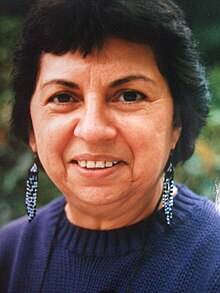
Gloria Evangelina Anzaldúa (September 26, 1942 – May xv, 2004)
Chicana literature [edit]
Since the 1970s, many Chicana writers (such every bit Cherríe Moraga, Gloria Anzaldúa and Ana Castillo) accept expressed their ain definitions of Chicana feminism through their books. Moraga and Anzaldúa edited an anthology of writing by women of color titled This Bridge Called My Back [57](published by Kitchen Tabular array: Women of Color Press) in the early 1980s. Cherríe Moraga, forth with Ana Castillo and Norma Alarcón, adapted this album into a Castilian-language text titled Esta Puente, Mi Espalda: Voces de Mujeres Tercermundistas en los Estados Unidos. Anzaldúa as well published the bilingual (Spanish/English) anthology, Borderlands/La Frontera: The New Mestiza. Mariana Roma-Carmona, Alma Gómez, and Cherríe Moraga published a collection of stories titled Cuentos: Stories by Latinas, likewise published by Kitchen Table: Women of Color Press.
The first Chicana Feminist Periodical was published in 1973, called the Encuentro Feminil: The First Chicana Feminist Journal, which was published by Anna Nieto Gomez.[58]
Juanita Ramos and the Latina Lesbian History Projection compiled an album including tatiana de la tierra'due south start published poem, "De ambiente",[59] and many oral histories of Latina lesbians called Compañeras: Latina Lesbians (1987).
Chicana lesbian-feminist poet Gloria Anzaldua points out that labeling a writer based on their social position allows for readers to empathise the writers' location in order. Yet, while it is important to recognize that identity characteristics situate the author, they do non necessarily reflect their writing. Anzaldua notes that this type of labeling has the potential to marginalize those writers who do not conform to the dominant civilization.[lx]
Chicana music [edit]
Continually left absent from Chicano music history, many Chicana musical artists, such every bit Rita Vidaurri and María de Luz Flores Aceves, more unremarkably known equally Lucha Reyes, from the 1940s and 50s, can be credited with many of strides that Chicana Feminist movements have made in the past century. For example, Vidaurri and Aceves were among the showtime mexicana women to wear charro pants while performing rancheras.[61]
By challenging their own conflicting backgrounds and ideologies, Chicana musicians take continually cleaved the gender norms of their culture, and therefore created a space for conversation and alter in the Latino communities.
There are many important figures in Chicana music history, each one giving a new social identity to Chicanas through their music. An important example of a Chicana musician is Rosita Fernández, an artist from San Antonio, Texas. Popular in the mid 20th century, she was called "San Antonio's Beginning Lady of Vocal" by Lady Bird Johnson, the Tejano vocalist is a symbol of Chicana feminism for many Mexican Americans nonetheless today. She was described as "larger than life", repeatedly performing in china poblana dresses, throughout her career, which last more than than 60 years. All the same, she never received a swell deal of fame outside of the San Antonio, despite her long reign every bit one of the well-nigh active Mexican American woman public performers of the 20th century.[62]
Other Chicana musicians and musical groups:
- Chelo Silva – Tejana Vocalist[63]
- Eva Ybarra – Tejana Accordionist (1945–)[64]
- Ventura Alonzo – Chicana Accordionist (1904–2000)[65]
- Eva Garza – Tejana Singer[66]
- Selena Quintanilla-Pérez – Tejana Vocalist (1971–1995)
- Gloria Ríos – Hispanic Singer[67]
- Girl in a Coma – Tejana indie rock ring from San Antonio
- Quetzal – E Los Angeles Chicano alternative stone band[68]
- Bags – Los Angeles punk stone ring, led past Alice Bag.
Notable people [edit]
- Alma M. Garcia - Professor of Sociology at Santa Clara Academy.
- Ana Castillo - Writer, Novelist, Poet, Editor, Essayist and Playwright who is recognized for depicting the true realities of the Chicana feminist feel.
- Anna Nieto-Gómez – Key organizer of the Chicana Move and founder of Hijas de Cuauhtémoc.
- Carla Trujillo - Writer, editor, and lecturer.
- Chela Sandoval – Associate Professor in the Chicano and Chicana Studies Department at University of California, Santa Barbara.
- Cherríe Moraga – Essayist, poet, activist educator, and creative person in residence at Stanford University.
- Dolores Huerta - Launched the National Farm Worker's Association with César Chavez in 1962 [69]
- Ester Hernandez - Through the use of art, using dissimilar mediums such as pastels, prints, and illustrations, she is able to depict the Latina/ Native women feel.
- Gloria Anzaldúa – Scholar of Chicana cultural theory and author of Borderlands/La Frontera: The New Mestiza, among other influential Chicana literature.
- Judithe Hernandez - Los Angeles based muralist who worked alongside Cesar Chavez to paint murals that broke the mainstream barrier in order to promote the Chicana movement.
- Martha Gonzalez (musician) - Chicana artivist and co-leader of Grammy-accolade-winning Quetzal (ring).
- Martha P. Cotera – Activist and writer during the Chicana Feminist Motion and the Chicano Ceremonious Rights Move.
- Norma Alarcón – Influential Chicana feminist author.
- Sandra Cisneros – Cardinal contributor to Chicana literature.
- Vicki L. Ruiz - American historian with a focus on Mexican-American women in the twentieth century.
- Elizabeth Martinez- longtime social justice activist and author.
Notable organizations [edit]
- Alianza Hispano-Americana - Founded in 1894, the Alianza members promoted borough virtues and acculturation, provided social activities and various wellness benefits and insurance for its members.[lxx]
- Chicas Rockeras South East Los Angeles – Promotes healing, growth, and confidence for girls through music education
- California Latinas for Reproductive Justice – Promotes social justice and homo rights of Latina women and girls through a reproductive justice framework
- Las Fotos Project – Empowers Latina youth, helping young girls to build self-esteem and confidence through photography and self-expression
- Museum of Latin American Art (MOLAA) – Located in Long Beach, CA this museum expands noesis and appreciation of modern and gimmicky Latin American art.
- National Clan for the Advocacy of Colored People (NAACP) - Civil rights system in the U.s., formed in 1909 by W. E. B. Du Bois, Mary White Ovington, and Moorfield Storey and Ida B. Wells in gild to advance justice for African Americans.
- National Chicano Youth Liberation Conference - Organized by the Cause for Justice, the event came from El Program Espiritual de Aztlan, which sought to organize the Chicano people around a nationalist programme.[70]
- National Labor Relations Board (NLRB) - A federal agency founded by Congress in 1935 to administer the National Labor Relations Act (NLRA) which protects employees' rights to organize and or serve in unions every bit bargaining representatives with their employers.[70]
- Ovarian Psycos - Immature feminists of color in East Los Angeles who empower women through their bicycle brigades and rides.
- Radical Monarchs - a radical social justice grouping located in California, for young girls of color to earn social justice badges. Influenced past Chocolate-brown Berets and Black Panthers, these young girls want to create change in their communities.[71]
Encounter also [edit]
- Black feminism
- Chicano studies
- Feminism in United mexican states
- Gender inequality in United mexican states
- Gypsy feminism
- Intersectionality
- Third-world feminism
- Womanism
- Latina stereotypes in hip hop
References [edit]
- ^ Garcia, Alma (1997). Chicana Feminist Thought: The Bones Historical Writings. Psychology Press. ISBN9780415918015.
- ^ "The Research Context", by Aída Hurtado. In Voicing Chicana Feminisms, by Aída Hurtado. (New York, NY: New York University Press, 2003).
- ^ a b c d Hurtado, Aída (Apr 1998). "Sitios y Lenguas : Chicanas Theorize Feminisms". Hypatia. thirteen (2): 134–161. doi:10.2979/HYP.1998.13.ii.134.
- ^ Stange, Mary Zeiss; Oyster, Carol; Sloan, Jane, eds. (2011). Encyclopedia of Women in Today's World. Chiliad Oaks, CA: SAGE Reference. pp. 249–251.
- ^ a b Garcia, Alma Grand. (1989). "The Development of Chicana Feminist Discourse, 1970-1980". Gender and Guild. 3 (ii): 217–238. doi:x.1177/089124389003002004. JSTOR 189983. S2CID 144240422.
- ^ Martínez, Elizabeth (1997). "La Chicana". In Garcia, Mario T. (ed.). Chicana Feminist Thought: The Bones Historical Writings. Psychology Printing. pp. 32–34. ISBN978-0-415-91801-v.
- ^ Hurtado, Aida (2003). "Review of Part I: Implications for Feminist Theorizing". Voicing Chicana Feminisms: Young Women Speak Out on Sexuality and Identity. NYU Printing. pp. 94–96. ISBN978-0-8147-3573-2.
- ^ NietoGomez, Anna (1997). "Chicana Feminism". In Garcia, Mario T. (ed.). Chicana Feminist Thought: The Basic Historical Writings. Psychology Press. pp. 52–57. ISBN978-0-415-91801-five.
- ^ Anzaldúa, G. (1999). La conciencia de la mestiza. In Borderlands/La Frontera: The New Mestiza (pp. 78-91). San Francisco, CA: Aunt Lute Books.
- ^ Exploring the Chicana Feminist Movement[ full citation needed ]
- ^ "UFW Chronology". United Farm Workers. Retrieved 2018-03-24 .
- ^ Kim, Inga (2017-04-03). "The Rise of the UFW". UFW . Retrieved 2020-03-03 .
- ^ "What is the Chicana Move?". umich.edu . Retrieved 2015-12-09 .
- ^ "1968 Due east L.A. Chicano Pupil Walkouts (Blowouts) | Los Angeles Salvation". www.laconservancy.org . Retrieved 2020-03-03 .
- ^ Smith, Olivia C. (October 2017). "Postcolonial Studies". Chicana Feminism.
- ^ Segura, Denise A.; Pesquera, Beatriz Thou. (ane January 1992). "Beyond Indifference and Antipathy: The Chicana Move and Chicana Feminist Discourse". Aztlan. xix (2): 69–92. OCLC 425546042.
- ^ "The Best of the Texas Century—Business". Texas Monthly. 2013-01-twenty. Retrieved 2018-12-07 .
- ^ Shabecoff, Philip Shabecoff (16 June 1973). "Farah Strike Has Get War of Attrition". The New York Times.
- ^ "Chicana Feminism". world wide web.umich.edu.
- ^ Blea, Irene I. 1992. La Chicana and the Intersection of Race, Course, and Gender. New York, NY: Praeger Publishers. 146.
- ^ Roth, Benita. 2004. Separate Roads to Feminism. New York, NY: Cambridge Academy Press. 12.
- ^ Herrera, Juan (22 January 2015). "¡La Lucha Continua! Gloria Arellanes and the Making of a Chicano Movement in El Monte and Across". Tropics of Meta.
- ^ Espinoza, Dionne (2001). "'Revolutionary Sisters': Women's Solidarity and Commonage Identification among Chicana Brown Berets in East Los Angeles, 1967–1970" (PDF). Aztldn. 26: 17–58.
- ^ "¡La Lucha Continua! Gloria Arellanes and Women in the Chicano Motility". KCET. 2015-03-26. Retrieved 2021-11-19 .
- ^ "Exploring the Chicana Feminist Movement". The Academy of Michigan. Retrieved 2015-06-09 .
- ^ a b Blackwell, Maylei (2016). ¡Chicana Power!: Contested Histories of Feminism in the Chicano Movement. Austin, TX: University of Texas Press. pp. 161–164. ISBN978-1477312667.
- ^ "Yo Soy Chicana: A Chicana Feminist Movement". KCET. 7 November 2011. Retrieved 24 March 2018.
- ^ Leon, Kendall (2013). "La Hermandad and Chicanas Organizing: The Customs Rhetoric of the Comisión Femenil Mexicana Nacional". Community Literacy Journal. vii (ii): 1–20. doi:10.1353/clj.2013.0004.
- ^ "The Enquiry Context", by Aída Hurtado. In Voicing Chicana Feminisms, past Aída Hurtado
- ^ a b c d Schroeder, Susan; Wood, Stephanie; Haskett, Robert (1997). "14". Indian Women in Early Mexico. University of Oklahoma Press. pp. 292–312. ISBN9780806129709.
- ^ a b Anzaldúa, Gloria (1987). Borderlands/La Frontera: The New Mestiza. p. 40. ISBN9781879960749.
- ^ Davalos, Karen Mary (2008). Yolanda One thousand. López. Los Angeles. Chicano Studies Research Eye University of California. Los Angeles: UCLA Chicano Studies Research Center Press. ISBN978-0-89551-103-iv. OCLC 236143155.
- ^ Jaffary, Nora E.; Osowski, Edward Westward.; Porter, Susie South., eds. (2009). "12. The Nahua Interpreter Malintzin Translates for Hernan Cortés and Moteucçoma (1580)". Mexican history : a principal source reader. Westview Press. p. 72.
- ^ Herrera, Cristina. Gimmicky Chicana Literature: (Re)Writing the Maternal Script. Amherst: Cambria Press, 2014.
- ^ Anzaldua, Gloria (1987). Borderlans/La frontera . Aunt Lute Books. p. 100. ISBN978-1-879960-12-1.
- ^ a b Tijerina-Revilla, Anita (2009). "Are All Raza Womyn Queer? An Exploration of Sexual Identity in a Chicana/Latina Student Arrangement". NWSA Journal. 21 (3): 46–62. JSTOR 20628194. ProQuest 233233515.
- ^ a b Galván, R. T. (2006). Campesina epistemologies and pedagogies of the spirit: Examining women'southward sobrevivencia. In D. Delgado Bernal, C. A. Elenes, F. Due east. Godinez, & Due south. Villenas (Eds.), Chicana/Latina education in everyday life: Feminista perspectives on pedagogy and epistemology (pp. 161–179). Albany: Country University of New York Printing.
- ^ Medina, Lara (2014). "Nepantla Spirituality: My Path to the Source(south) of Healing". In Facio, Elisa; Lara, Irene (eds.). Fleshing the Spirit: Spirituality and Activism in Chicana, Latina, and Indigenous Women's Lives. University of Arizona Press. pp. 167–186. ISBN978-0-8165-9891-5.
- ^ Keating, AnaLouise (2006). "From Borderlands and New Mestizas to Nepantlas and Nepantleras: Anzaldúan Theories for Social Alter" (PDF). Human Architecture. 4: v–16. ProQuest 210142942.
- ^ a b Bost, Suzanne (2009). Encarnacion : Illness and Body Politics in Chicana Feminist Literature. Fordham University Press. pp. 193–234. ISBN9780823230846.
- ^ Moya, Paula Thou. L. (2001). "Chicana Feminism and Postmodernist Theory". Signs. 26 (2): 441–483. doi:10.1086/495600. ISSN 0097-9740. JSTOR 3175449. S2CID 145250119.
- ^ Anzaldua, Gloria (1987). Borderlands La Frontera The New Mestiza, 4th Edition. San Francisco: aunt lute. pp. 99–114.
- ^ a b Vázquez, Francisco H (2009). Latino/a Thought : Civilization, Politics, and Club. Rowman & Littlefield Publishers. p. 212. ISBN9780742563544.
- ^ a b c Trujillo, Carla (1991). Chicana Lesbians: The Girls Our Mothers Warned The states About. Tertiary Woman Press. pp. 186–195. ISBN9780943219066.
- ^ Maythee, Rojas (2009). Women of Colour and Feminism. Berkeley, California: Seal Press. p. 65. ISBN978-1-58005-272-6.
- ^ Alma M., Garcia (1997). Chicana Feminist Thought: The Bones Historical Writings. Routledge.
- ^ Dicochea, Perlita R. (2004). "Chicana Critical Rhetoric: Recrafting La Causa in Chicana Movement Discourse, 1970-1979". Frontiers: A Journal of Women Studies. 25 (1): 77–92. doi:10.1353/fro.2004.0032. S2CID 143518721.
- ^ Garcia, Alma M. (2014-04-23). Garcia, Alma M (ed.). Chicana Feminist Thought. doi:10.4324/9780203760642. ISBN9780203760642. [ page needed ]
- ^ a b c d e f thou h Zetterman, Eva (1 March 2016). "Claims by Anglo American feminists and Chicanas/os for alternative space: The LA art scene in the political 1970s". American Studies in Scandinavia. 48 (ane): 61–83. doi:10.22439/asca.v48i1.5361.
- ^ Langlois, Jessica (March 3, 2017). "How United mexican states's Zapatistas Helped Inspire a Feminist, Chicana Art Motion of East Fifty.A." LA Weekly.
- ^ "The 'Peppery' Visions of Iconic L.A. Artist Carlos Almaráz". KQED. 2017-09-15. Retrieved 2018-12-07 .
- ^ "Iconic LA mural SAVED: "La Ofrenda" past Yreina Cervantez". SPARCinLA . Retrieved 2018-12-07 .
- ^ Vankin, Deborah (30 September 2017). "Later on 27 years in a warehouse, a in one case-censored mural rises in Fifty.A.'southward Union Station". Los Angeles Times . Retrieved 2018-12-07 .
- ^ Miranda, Carolina A. (25 April 2018). "Photographer Laura Aguilar, chronicler of the body and Chicano identity, dies at 58". Los Angeles Times . Retrieved 2018-12-07 .
- ^ Miranda, Carolina A. (19 Oct 2018). "Guadalupe Rosales used Instagram to create an archive of Chicano youth of the '90s — now it's an art installation". Los Angeles Times . Retrieved 2018-12-07 .
- ^ Serna, Cristina (2017). "Locating A Transborder Annal of Queer Chicana Feminist and Mexican Lesbian Feminist Art". Feminist Formations. 29 (3): 49–79. doi:10.1353/ff.2017.0030. S2CID 149087764.
- ^ Adair, Cassius; Nakamura, Lisa (June 2017). "The Digital Afterlives of This Span Called My Back : Adult female of Color Feminism, Digital Labor, and Networked Pedagogy". American Literature. 89 (two): 255–278. doi:x.1215/00029831-3861505.
- ^ Castillo, Anna (2014). Massacre of the Dreamers : Essays on Xicanisma. 20th Anniversary Updated Edition. University of New Mexico Press. p. 35. ISBN9780826353580.
- ^ De La Tierra, Tatiana. "Activist Latina Lesbian Publishing: esto no tiene nombre and conmoción." I am Aztldn: The Personal Essay in Chicano Studies, ed. Chon A. Noriega and Wendy Belcher (Los Angeles: UCLA Chicano Studies Research Center Press, 2004) 172.
- ^ Anzaldua, Gloria. (1994). To(o) Queer the Writer—Loca, escritoria y chicana. from Betsy Warland, Ed., Inversions: Writings by Queer Dykes and Lesbians, 263-276. Vancouver: Press Gang Publishers.
- ^ Vargas, Deborah (2012). Dissonant Divas in Chicana Music: The Limits of la Onda. The University of Minnesota Press. p. vii. ISBN978-0-8166-7316-ii . Retrieved 2015-06-09 .
- ^ Vargas, Deborah (2012). Dissonant Divas in Chicana Music: The Limits of la Onda. The University of Minnesota Press. p. iii. ISBN978-0-8166-7316-two . Retrieved 2015-06-09 .
- ^ Rodríguez, Juan Carlos. "Silva, Consuelo [Chelo]". Texas State Historical Association.
- ^ "Eva Ybarra - American Sabor". Archived from the original on 2017-05-04. Retrieved 2015-06-10 .
- ^ "KUTX » Ventura Alonzo, Queen of the Squeeze box". 31 December 2012.
- ^ "GARZA, EVA - The Handbook of Texas Online- Texas State Historical Association (TSHA)". 30 June 2014.
- ^ "Gloria Ríos: La reina ignorada del rock and roll mexicano".
- ^ "Women Who Stone Oral History Archive :: Martha Gonzalez".
- ^ "Dolores Huerta | Dolores Huerta Foundation". doloreshuerta.org . Retrieved 2020-03-03 .
- ^ a b c Ruiz, Vicki L. (1998). From Out of the Shadows. New York: Oxford University Press Inc.
- ^ "Radical Monarchs". Radical Monarchs. October 2018. Retrieved Oct eight, 2018.
Further reading [edit]
- Anzaldúa, Gloria, and Cherríe Moraga, editors. This bridge called my back: writings by radical women of colour. Watertown, Massachusetts: Persephone Press, c1981., Kitchen Table Press, 1983 ISBN 0-930436-x-five.
- Alarcón, Norma; Castillo, Ana; Moraga, Cherríe, eds. (1989). The Sexuality of Latinas. Third Woman. OCLC 555824915.
- Anzaldúa, Gloria. Borderlands/La Frontera: The New Mestiza, Aunt Lute Books, ISBN 1-879960-56-7
- Anzaldúa, Gloria. Making Face. Making Soul: Haciendo Caras: Artistic & Critical Perspectives by Feminists of Color, Aunt Lute Books, 1990, ISBN 1-879960-ten-9
- Arredondo, Gabriela, et al., editors. Chicana Feminisms: A Critical Reader. Durham, Due north Carolina: Duke University Press, 2003. ISBN 0-8223-3105-five.
- Balderrama, Francisco. In Defence of La Raza: The Los Angeles Mexican Consulate and the Mexican Community, 1929–1936. Tucson: Academy of Arizona Press, 1982.
- Castillo, Adelaida R. Del (2005). Between Borders: Essays on Mexicana/Chicana History. Floricanto Press. ISBN978-0-915745-70-8.
- Castillo, Ana. Massacre of the dreamers : essays on Xicanisma. Albuquerque: University of New Mexico Press, 1994. ISBN 0-8263-1554-two.
- Cotera, Martha. The Chicana feminist. Austin, Texas: Information Systems Development, 1977.
- Córdova, Teresa (December 1998). "Anti‐colonial Chicana feminism". New Political Science. 20 (four): 379–397. doi:ten.1080/07393149808429837.
- Davalos, Karen Mary (2008). "Sin Vergüenza: Chicana Feminist Theorizing". Feminist Studies. 34 (1/ii): 151–171. JSTOR 20459186.
- Dicochea, Perlita R. (2004). "Chicana Critical Rhetoric: Recrafting La Causa in Chicana Motility Discourse, 1970-1979". Frontiers. 25 (1): 77–92. doi:10.1353/fro.2004.0032. JSTOR 3347255. S2CID 143518721.
- DuBois, Ellen Carol, and Vicki L. Ruiz, eds. Unequal Sisters: A multicultural Reader in U.Southward. Women's History. New York: Routledge, 1990.
- García, Alma M., and Mario T. Garcia, editors. Chicana Feminist Thought: The Basic Historical Writings. New York: Routledge, 1997. ISBN 0-415-91800-6.
- Garcia, Alma M. (1989). "The Development of Chicana Feminist Discourse, 1970-1980". Gender and Society. 3 (2): 217–238. doi:ten.1177/089124389003002004. JSTOR 189983. S2CID 144240422.
- Havlin, Natalie (2015). "'To Live a Humanity under the Peel': Revolutionary Love and 3rd World Praxis in 1970s Chicana Feminism". Women's Studies Quarterly. 43 (3/4): 78–97. doi:x.1353/wsq.2015.0047. JSTOR 43958552. S2CID 86294180.
- Hurtado, Aida. The Color of Privilege: Three Blasphemies on Race and Feminism. Michigan: Academy of Michigan Press, 1996. ISBN 978-0-472-06531-8.
- Moya, Paula 1000. L. (2001). "Chicana Feminism and Postmodernist Theory". Signs. 26 (2): 441–483. doi:10.1086/495600. JSTOR 3175449. S2CID 145250119.
- Ramos, Juanita. Companeras: Latina Lesbians, Latina Lesbian History Project, 1987, ISBN 978-0-415-90926-6
- Rodriguez, Samantha M. (2014). "Etching Spaces for Feminism and Nationalism: Texas Chicana Activism during the Chicana/O Movement". Periodical of South Texas. 27 (ii): 38–52. EBSCOhost 109928863.
- Roots of Chicano Politics, 1600–1940. Albuquerque: University of New United mexican states Press, 1994.
- Roma-Carmona, Mariana, Alma Gomez and Cherríe Moraga. Cuentos: Stories past Latinas, Kitchen Table: Women of Color Press.
- Roth, Benita. Split up Roads to Feminism: Black, Chicana, and White Feminist Movements in America'due south Second Wave, Cambridge Academy Press, 2003, ISBN 0-521-52972-7
- Ruiz, Vicki Fifty. From out of the Shadows. Oxford Academy Publishing Inc., 1998.
- Saldivar-Hull, Sonia (April 1999). "Women hollering transfronteriza feminisms". Cultural Studies. 13 (2): 251–262. doi:10.1080/095023899335275.
- Trujillo, Carla, ed. Chicana Lesbians: The Girls Our Mothers Warned Us Most. Berkeley, Calif.: Third Adult female Press, 1991.
- Pérez, Ricardo F. Vivancos (2013). Radical Chicana Poetics. Springer. ISBN978-i-137-34358-ane.
- Whaley, Charlotte. Nina Otero-Warren of Santa Fe. Albuquerque: University of New Mexico Press, 1994.
External links [edit]
- Chicana Feminisms Page
- History of Chicanas page
- Chicana Community Search Folio
Source: https://en.wikipedia.org/wiki/Chicana_feminism
0 Response to "The Art of Music a Narrative History of Music Mason"
Publicar un comentario